
Tai chi origin: where it began
In case you don’t know: there is not ONE Tai Chi (Taijiquan), but there are many different styles. Although all styles come from China, they come from different places.
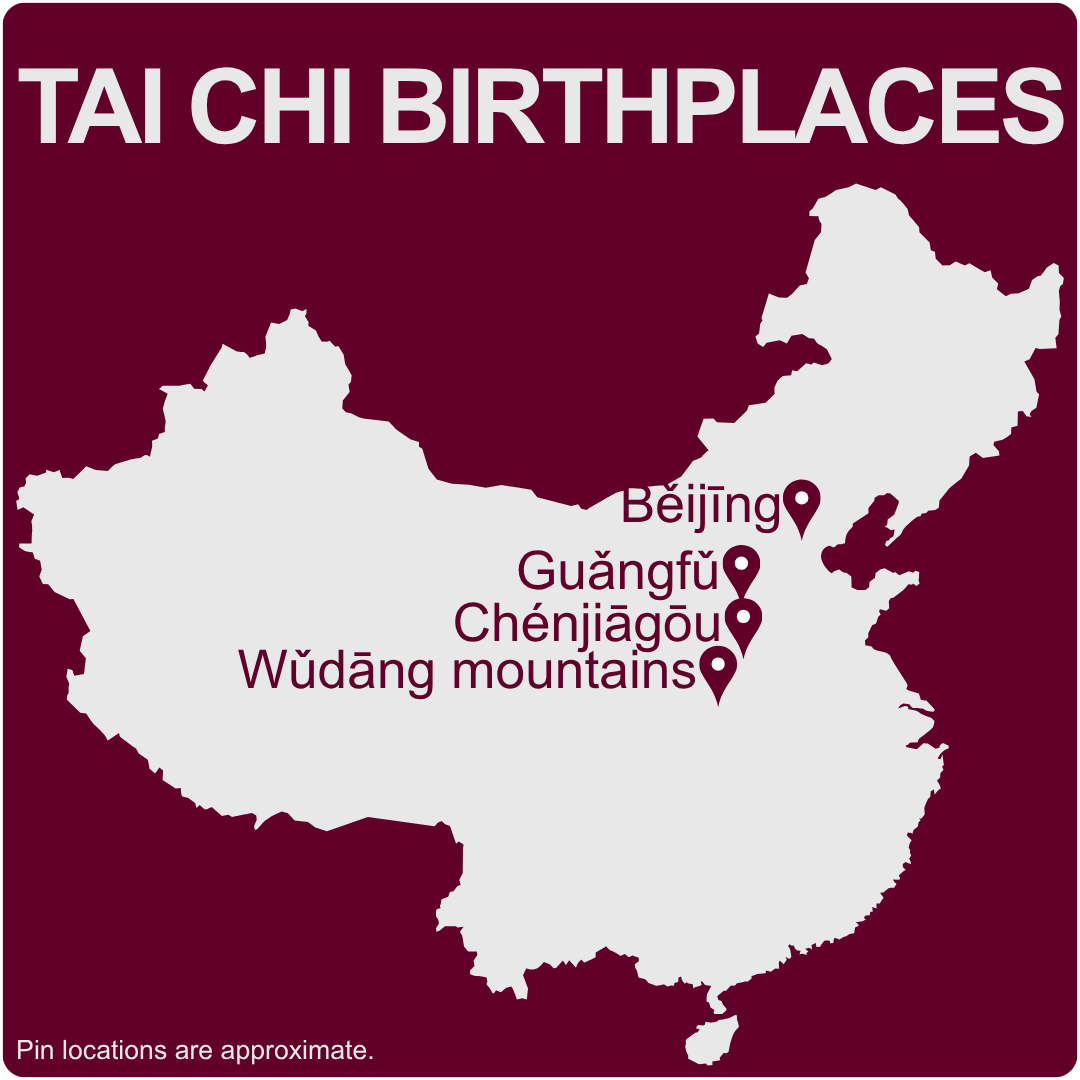
Tai chi origin: the birthplaces of the major styles
- Chen style Taijiquan: Chénjiāgōu village, Wèn county, Hénán province.
- Yang style Taijiquan: Guǎngfǔ town, Yǒngnián county, Héběi province.
- Wu/Hao style Taijiquan: the same town as Yang style, Guǎngfǔ, Yǒngnián county, Héběi province.
- Wu style Taijiquan: no single village. Wú Quányòu developed it in Běijīng, blending what he learned from the Yang family while serving as a guard in the Forbidden City.
- Sun style Taijiquan: also not a village story. Sūn Lùtáng created it in Běijīng, around 1912 to 1921.
- Wudang style Taijiquan: this one is based on a legend. It is said to come from the Wǔdāng mountains in Húběi province, created by the Taoist sage Zhāng Sānfēng after watching a snake and a crane fight. It is not certain that Zhāng Sānfēng ever existed.
It is fun to learn about the Taijiquan origin, its history, and the cultural references. Interestingly, the oldest style (Chen) is not the most common in the West. I did a survey a couple of years ago and Yang style remains by far the most widely practiced outside China.
As there are so many styles, there is a lot of feuding about who has the most authentic style, form, and moves. Surprisingly, internal martial artists engage in many keyboard battles.
Why I care more about the teacher than the lineage
Instead of bickering about who does the best Single Whip, I would like to see more discussions about how to teach well. How to structure a class or a workshop. How to actually help people get better, instead of sending them home with the short sentence: “just practice daily.”
For me, when I am standing in a workshop or class, I don’t care which village your Taijiquan is from. Or as one of my teachers used to say:
“Knowledge is more important than lineage.” (Howard Choy)
Finding a teacher with real knowledge and skill matters more than finding one with an impeccable lineage. Let me be clear: I am not dismissing heritage and authenticity. If someone studied for decades under a respected master, that says something about their training. It means they are a good student.
But being a good student and being a good teacher are two different things.
There are no official rules about who can teach Taijiquan. You can do one weekend workshop and start teaching the following week, and nobody will stop you. That is exactly why lineage carries so much weight. Being an x-th generation student, or training directly under a well-known master, can make you a great Taijiquan practitioner.
However, I have been to workshops with teachers of impressive skills, and yet they failed to properly teach the class. Some teachers were skilled at dodging questions, even when they clearly knew the answer. Some expected us to extract the knowledge by simply watching. I understand the concept of “stealing with your eyes”, but that is no excuse to not explain anything.
So when knowledge is more important than lineage, it’s not only about where to place your hand. It’s also about how to teach a class, how to help people learn.
Adding modern times to the art does not mean to dismiss its roots.
Taijiquan never stops changing
Taijiquan comes from many places in China, there are many styles and opinions. It has always been changing, adapting. Masters added their own spin. Taijiquan in China today is not the same as it was four hundred years ago, let alone what we practice in the West nowadays. This internal art moves through different bodies and different generations, and it changes a little with each one.
The question of Taijiquan origin is interesting, but I find myself wondering: what about the road ahead?
How can we honour what was passed down to us, while making room for modern teaching methods and technology?