
Magpie Bridge: the Qi Gong tongue position I practised for years without knowing its name
Recently, my Tai Chi teacher said a term in class that was new to me: magpie bridge (in German: Elsterbrücke).
Magpie Bridge (Què Qiáo) is when you touch your tongue to the roof of your mouth.
I have done that so many times, for many years. I was astonished that I had never heard that term before. It’s not even in my Taijiquan & Qi Gong Dictionary*, which I wrote in 2017.
So I got curious and wanted to learn more about it.
Searching for the Magpie Bridge
I went through a lot of books on my shelf. It is such a common thing to do for Qi Gong and Tai Chi people. It’s so common and yet does not appear in the indexes or glossaries.
Then I found it in The Way of Qigong* by Kenneth S. Cohen. It is a very well-known book, but even there, it does not say magpie bridge. Instead, it uses the Chinese instruction Shé Dǐng Shàng È:
“SHE DING SHANG E. ‘Tongue touches the roof of the mouth.’ Keep the mouth relaxed, the lips lightly touching. Unless otherwise specified or unless you are exhaling through the mouth, it is best to keep the tongue gently touching a comfortable place on the upper palate. This is useful for two reasons. First, it generates saliva, which should be swallowed when necessary, preventing the mouth or throat from drying out. According to Daoism, saliva is the body’s ‘longevity liquor.’ The second reason is that the body’s major yang meridian ends at the upper palate while the yin meridian begins at the tip of the tongue. By touching these points together, an important energy circuit is closed, allowing the qi to circulate with a stronger current. A stronger current means more energy and vitality.”
Let’s look at Shé Dǐng Shàng È (舌顶上腭). The four characters are quite literal:
- 舌 shé: tongue
- 顶 dǐng: to press up against
- 上 shàng: upper
- 腭 è: palate
So Shé Dǐng Shàng È simply means “tongue presses the upper palate.” It describes exactly what you do, nothing more. No magpies in sight.
I continued searching for the magpie bridge online and found an article by Dr. Yang, Jwing-Ming on the YMAA website. Finally, there it was:
“This tongue connection is also called ‘building the magpie bridge’ (Da Que Qiao).”
In Pinyin with tones, it is Dā Què Qiáo (搭鹊桥):
- 搭 dā: to build, to put up
- 鹊 què: magpie
- 桥 qiáo: bridge
Like Cohen, Dr. Yang emphasises that with the tongue up, the Qi can flow between the Conception Vessel (Rèn Mài) and the Governing Vessel (Dū Mài). Actually, it is an important part of the Small Circulation, Xiǎo Zhōu Tiān (小周天), also called the Microcosmic Orbit. In this Qi Gong practice, the Qi circulates in a circle through these two vessels.
Now I learned the Magpie Bridge was the term for that. But what does that have to do with magpies?
The Cowherd and the Weaver Girl
The name comes from a Chinese legend, The Cowherd and the Weaver Girl. The Weaver Girl (Zhīnǚ) is a fairy from heaven. She falls in love with a poor cowherd (Niúláng) on earth, and they marry. But heaven does not allow it. The Queen Mother of the West draws a river across the sky to keep them apart: the Milky Way.
Once a year, on the seventh day of the seventh lunar month, magpies fly up and form a bridge so the two lovers can meet. In China, this day is still celebrated as the Qīxī Festival (七夕), sometimes called Chinese Valentine’s Day.
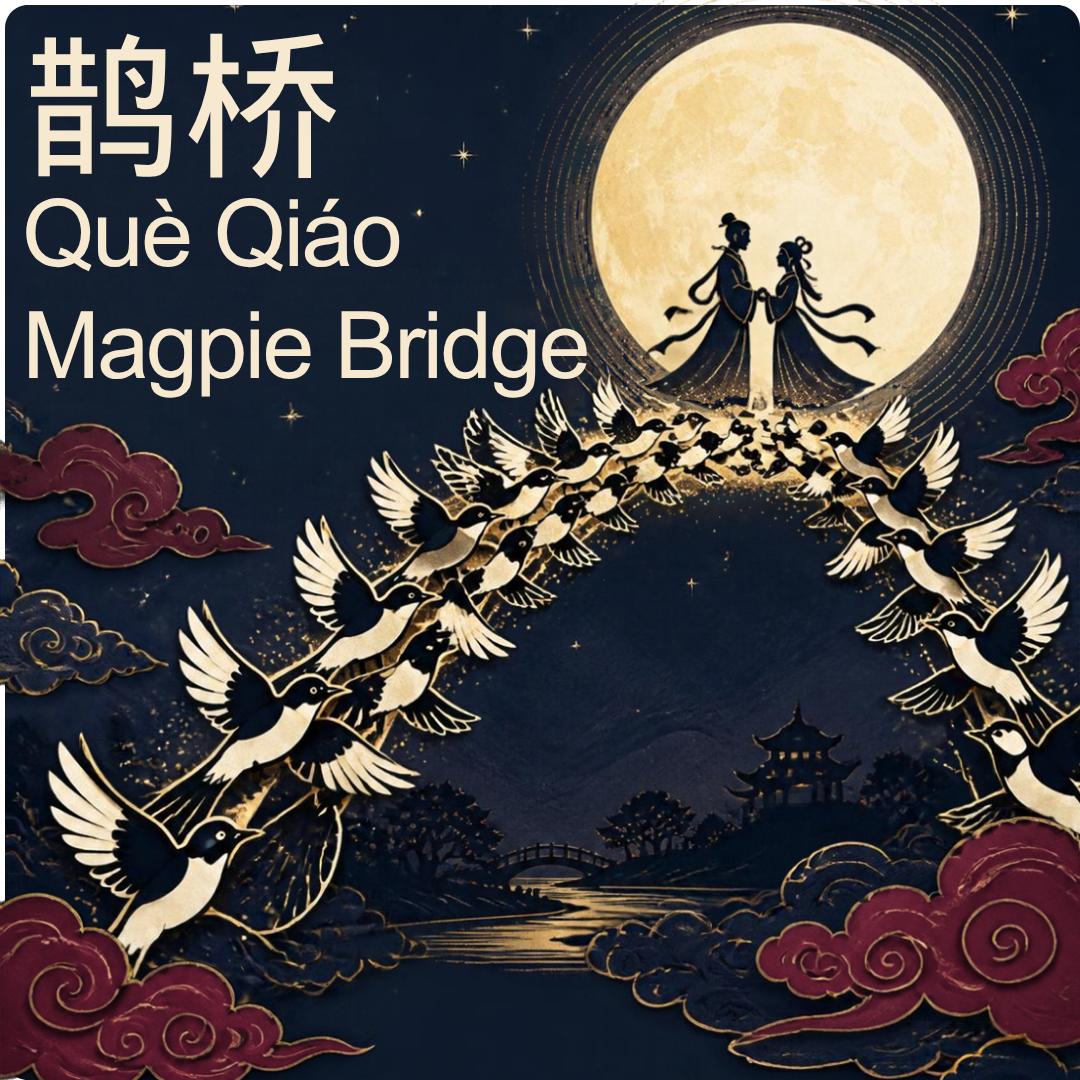
I like that the name comes from such a lovely story. It clearly shows how the different vessels are connected. Like the two lovers, Rèn Mài and Dū Mài are separated, and the tongue becomes the bridge that brings them together.
How to build the Magpie Bridge
Building the Magpie Bridge is simple. Gently touch the tip of your tongue to the roof of your mouth. As Cohen writes, look for a comfortable place on the upper palate. There is no need to press.
Dr. Yang mentions that at first, you might feel some tension at the root of the tongue. For me, it has always felt very natural. I have known the tongue position for many years, and I find it very comfortable. I sometimes do it outside of practice, because it helps me to relax my mouth.
Also worth noting: with the magpie bridge, one does not breathe out through the mouth. Try it!
I really enjoyed my research for the Magpie Bridge, I enjoyed learning something new.
Did you know the term Magpie Bridge before?
Happy Qi!
Angelika