
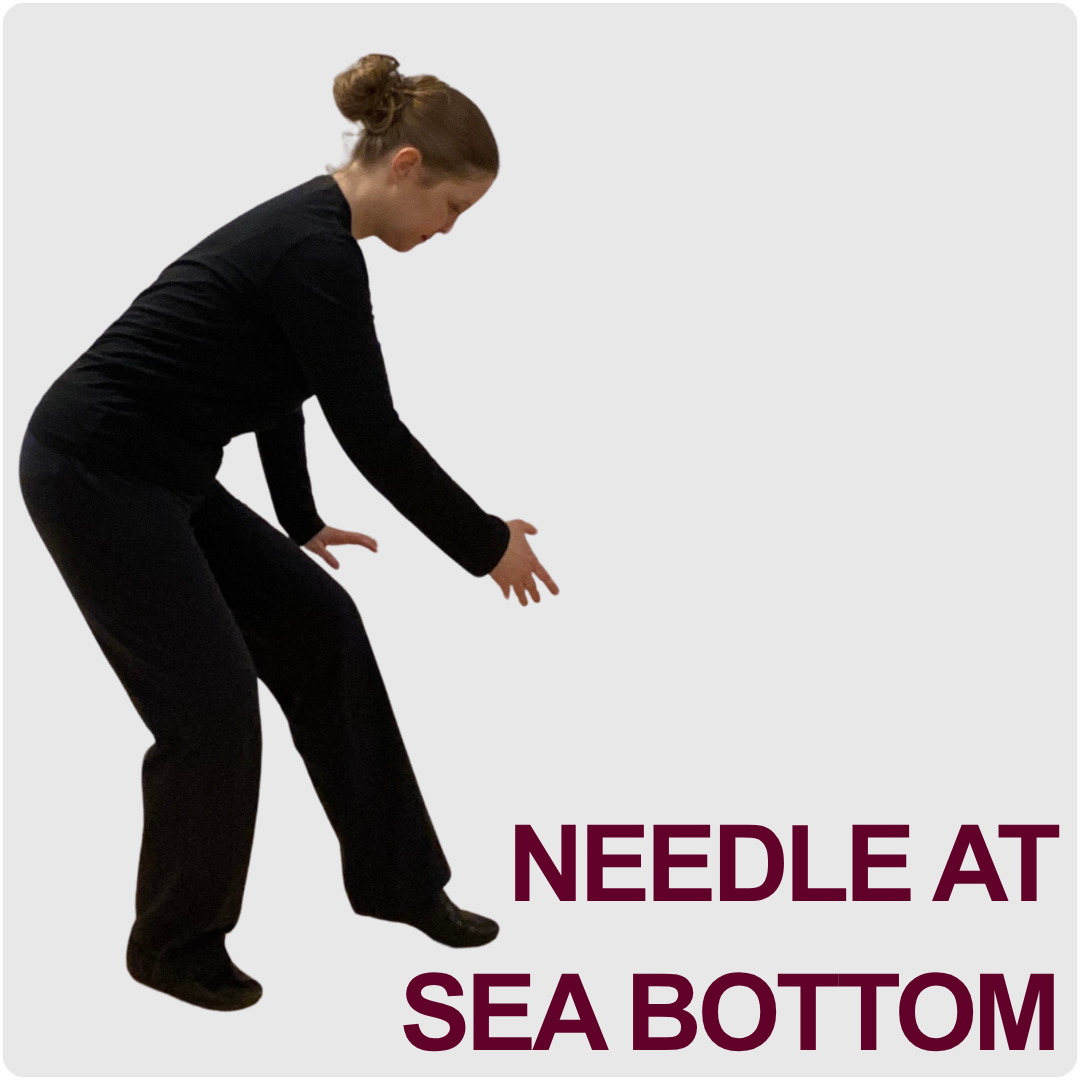
Needle at Sea Bottom: the stories behind a Tai Chi move’s name
Last summer I read Real Americans by Rachel Khong*. I read the book in German, and one paragraph stayed with me. It went something like this:
“That’s impossible.” Ping sounded annoyed. “Dà hǎi lāo zhēn.” Like fishing a needle out of the sea. (German edition, page 391)*
Uups, I thought, is that a Chinese saying? And how does that relate to the Taijiquan move Needle at Sea Bottom (Hǎi Dǐ Zhēn)? So I researched online and in various books. And I found a lot of different stories behind that name.
The Chinese saying dà hǎi lāo zhēn
I don’t speak Chinese, but 大海捞针 (dà hǎi lāo zhēn) is a common Chinese phrase: “to scoop for a needle in the vast ocean”. It can also be said as 海底捞针 (hǎi dǐ lāo zhēn): “scooping a needle from the sea floor”. In English, one would say “to look for a needle in a haystack”.
In comparison, the Taijiquan move is called 海底针 Hǎi Dǐ Zhēn: a needle at the bottom of the sea. Just one Chinese character is missing: 捞 (lāo): to scoop.
I wondered: is the move really about something impossible to find? Because the move is not a scooping move, it’s more like pricking down with the fingers.
Needle at Sea Bottom in the books
I searched three Taijiquan books to see whether I could find more details about the form move name.
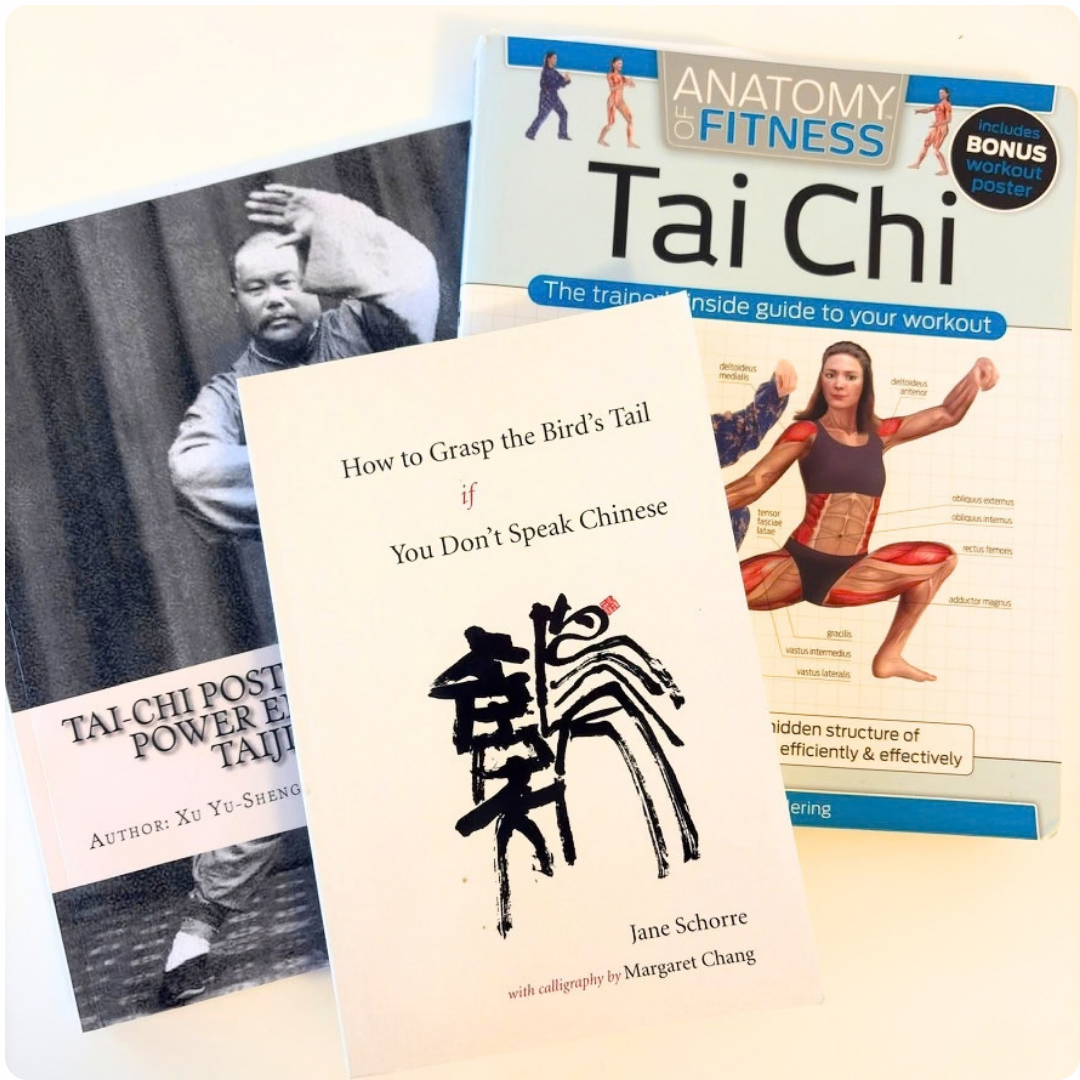
- Anatomy of Fitness: Tai Chi by Loretta M. Wollering*
- Tai-Chi Postures & Internal Power Enhancement by Xu Yu-Sheng and Bradford Tyrey*
- How to Grasp the Bird’s Tail if You Don’t Speak Chinese by Jane Schorre*
Each book had its own explanation, and some had more than one. None of them mentioned the Chinese saying, but I found three different stories.
A magic staff the size of a needle
Anatomy of Fitness* mentions an old Chinese story about a magical staff that could be made as small as a needle. How to Grasp the Bird’s Tail* tells the full story. It comes from Journey to the West (Xī Yóu Jì), where the Monkey King finds his perfect weapon at the bottom of the Eastern Sea:
Monkey found this to be the perfect weapon because he could use his magic powers to shrink it from its twenty foot length to two feet for fighting, and then to the size of a needle to stick behind his ear. How to Grasp the Bird’s Tail if You Don’t Speak Chinese by Jane Schorre, page 60*
I like the idea of a staff that can change its size. But honestly, I am not sure how it connects to the move itself.
Sea bottom as a place on the body
The second story is a martial one. Anatomy of Fitness* mentions that “sea bottom” refers to the lower part of the opponent’s body. The intent must be strong enough to pick up a needle even from the depths of the sea. Tai-Chi Postures* goes into more detail:
This cavity-point can only be reached by poking deeply into the bladder, which is considered to be the ocean, in that it is full of water. The hand is the needle, which inserts until the bottom of the ocean is reached. Tai-Chi Postures & Internal Power Enhancement by Xu Yu-Sheng and Bradford Tyrey, pages 51-53*
The Chinese name of the move is Hǎi Dǐ Zhēn. And Hǎi Dǐ is actually also an alternative name for the acupuncture point Huì Yīn. Hǎi Dǐ means sea bottom, and Huì Yīn means Meeting of Yīn. The point sits at the perineum, at the very base of the torso. In Qín Ná, the martial art of seizing and locking, it is even listed as a cavity striking point (dǎ xué).
A needle in the depths of the sea
The third story is very different and more poetic. How to Grasp the Bird’s Tail* tells a story about a very special needle:
There was once an old Daoist monk who was known for his skill at embroidering. People who came to admire his work would often ask him to teach them the secret of his ability to create such beauty. He always told them, “I can only show you what my hands do. I can not show you the Golden Needle that produces them. You must find that for yourself.” The Golden Needle is found at the bottom of the sea – in the deep reservoir that is the source of all creativity. How to Grasp the Bird’s Tail if You Don’t Speak Chinese by Jane Schorre, page 60*
I love the image of an embroidery needle. It is small and very precise. That’s how the move feels to me: small and precise, because Needle at Sea Bottom is not the most flashy move in the form.
Pricking, not stabbing
Actually, in the book Tai-Chi Postures*, there is also a different take on the needle. The authors distinguish the different parts of the move, they named the second part 海底针刺 (hǎi dǐ zhēn cì): Ocean Bottom Needle Stabs.
Ci refers to pricking something, as if with a needle. Stabbing is somewhat suitable in its meaning but, Master Fu [Fù Zhōngwén] explained that pricking is a penetrating action that is very precise, containing no brutish force. Tai-Chi Postures & Internal Power Enhancement by Xu Yu-Sheng and Bradford Tyrey, pages 51-53*
So again, Needle at Sea Bottom is not a big or stabbing move, but small and precise. Pricking also makes clearer that the fingers point toward the bottom. Very precise, but still powerful and pushing through.
What I learned without finding the answer
So basically, I am still not sure where the name Needle at Sea Bottom comes from. But it was fascinating to learn about the Chinese phrases and stories. Maybe you know more about it? Feel free to write in the comments if you have more information.
Happy Qi!
Angelika