
Do you really know the Tai Chi form? 5 ways to find out
Do you remember the first time you tried to do the Taijiquan form by yourself? In class, following along with the teacher, it was easy. But alone at home in your living room, suddenly the next move was not clear anymore. With practice, though, you managed to do the form on your own.
Once you can do the form on your own, there comes the next level: do you REALLY know the form? How comfortable are you with the order of the form, the directions, the body moves?
I think for a more experienced Taijiquan practitioner, there are five ways of testing whether you truly know the form.
1. Run the form really slowly
To be honest, I think the term “running the form” is a bit misleading. Especially when you want to find out if you really know the form. So try it the other way around: do the form realllllly slowwwww. So slow that it feels uncomfortable for your mind.
Practising slowly, you constantly need to remember where in the form you are. Especially with moves that happen several times during the form, like Cloud Hands or Brush Knee. It’s easy to suddenly continue at a different part of the form.
It’s interesting to practise like that, because it shows that the form is not only about the external moves. It’s also about what happens inside. Taijiquan is an internal martial art, after all.
2. Speed up the form
Instead of going really slowly, try the opposite: speed it up. Get really into it and fly through it. Again, it will show you which parts of the form are not yet secure in your body and mind.
For me, this very fast way of practising shows specifically how well I know the transitions between the moves. Try it, it’s fun!
3. Change directions
Here you have two options. The first one is to simply change your position. If you usually start facing the window, start facing the wall instead. That alone is already quite confusing!
But there is an additional way, which is also very confusing: mirror the form. So if you usually open to the right, start to the left. Change which arm moves up first, which leg moves first, and so on.
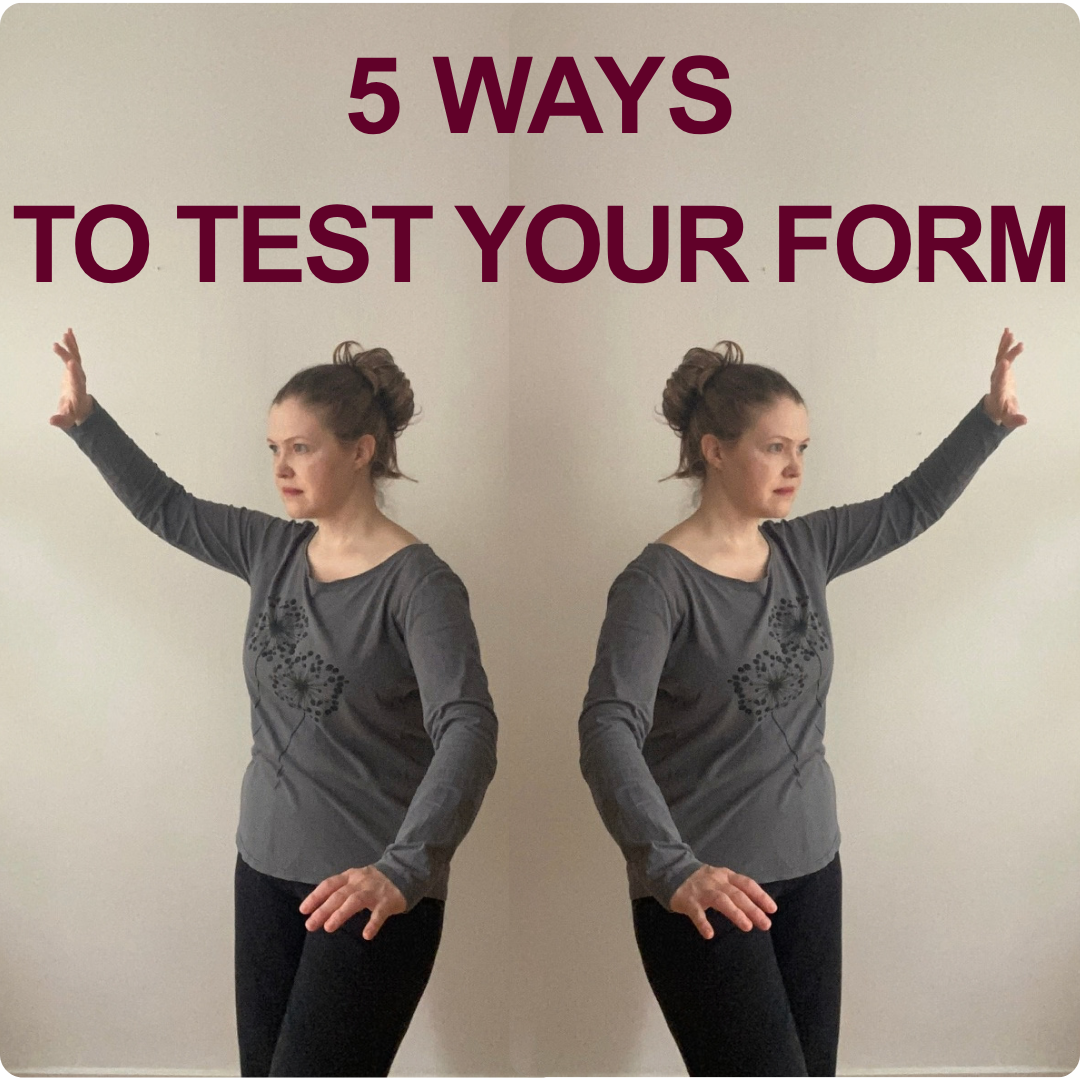
This way of doing the Taijiquan form shows very clearly which moves I’m not sure about yet, because I really need to think about which body part goes where. It helps to remember the Yin and Yang of the moves. For me, it’s one of the hardest ways to do the form. Very challenging, and I haven’t mastered it myself yet.
4. Practise in your head
As you sit right now, try this: close your eyes and start doing the Taijiquan form in your head. It’s easiest if you imagine being in the room where you practise most. Just see how far you get…
… I’ll wait, just try it now!
…
So how did that go? It’s a wonderful way to practise while you wait at the doctor’s or for public transport. And moving in your mind is what a lot of athletes do. It’s easy on your body too. For example, if you are in pain during the form, practising in your mind can help you without using your body.
Or, if that is too hard, try making an audio of your form. I have recorded the Cheng Man-ching 37 form, if you want to try that.
5. Start teaching
I’m not teaching at the moment, but I did teach Taijiquan many years ago. And I found that it really helped my own practice. Not only because I was leading the form, and obviously, when all eyes are on you, you give your best.
The questions from students were helpful too. They can ask things I have never thought about. Or a question reminds me of something my own teacher used to say.
I think explaining something to someone else is a good way to figure out if I understand it myself. Obviously, teaching is not for everyone, but I wanted to mention it. And thinking about it, maybe I’ll teach again one day. I always enjoyed the interactions.
Never really done
So these are my five ways to figure out if I know the form.
Obviously, with Taijiquan, one is never “done”. There is always more to learn, more to figure out, and more body parts slowly changing over time that make the form different (crackling knees, anyone?). I recently read this in a book:
“Uncle used to intone that it took two lifetimes to learn Taichi.”
Marc Meyer, Taichi: The Story of a Chinese Master in America*
There is always something to improve. But at least there is a point in the Taijiquan journey when you feel comfortable with the form.
Do you have anything to add? How do you test if you really know the form?