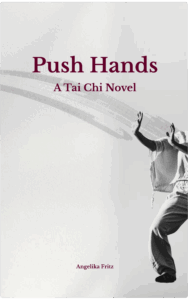
Push Hands: My First Tai Chi Novel
For years, I have been writing about Taijiquan. A dictionary. Blog posts. Reference articles. All of them non-fiction, all of them trying to get things right.
Then an idea hit. An idea for a Tai Chi novel!
When I started writing, it was strange at first. To write fictionally. To just go with the flow. To allow the characters in my novel to make mistakes. I really enjoyed the creative freedom that came with writing a novel.
Also, I was excited to write a Tai Chi novel, because there are not many out there. Some exist, but not many. And I thought: wouldn’t it be wonderful to spend time with this practice through a story? Not a manual, not a how-to guide. Just a story about people who do Tai Chi, told with warmth and a little humour.
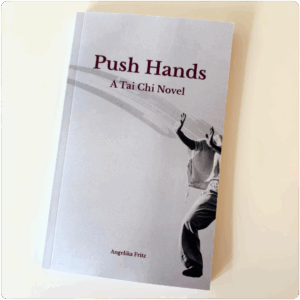
So I wrote Push Hands. A Tai Chi Novel*.
What the book is about
Push Hands* is set during a weekend Tai Chi workshop. I wanted to keep the scope small and intimate. I wanted to make it feel real.
A workshop is a contained world. You arrive as strangers, or near-strangers, and learn, move, laugh together. A lot can happen in a weekend. I tried to capture all the little moments, the little conversations, in my book.
However, this workshop is not all happy, happy. The book has seven chapters. In Chinese numerology, seven is the number for conflict. So there is tension. There are underlying conflicts. I had a lot of fun exploring those moments. The conversations that reveal what people really think. Or at least what I think people think.
I had so much fun writing this book. I hope you enjoy reading it as much as I enjoyed creating it.
The characters: the people we all recognise
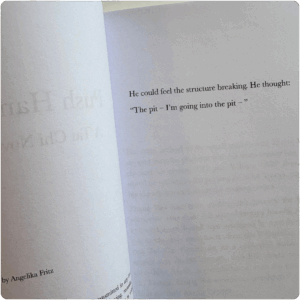
When I started the book, I really enjoyed building the characters. I wanted to capture the typical Tai Chi enthusiasts. Who are these people? What do they do outside of Tai Chi? What are they looking for when they come to a workshop? Each character has their own background, their own wounds, their own reasons for being in that room.
Ok, and then I let “mean girl Angelika” take over. Just a little bit. I am kind and friendly in real life, but writing that book, I did allow myself to have — let’s say — honest observations.
Just to be clear: I don’t dislike any of the people in my book. Every single character has something to say. Some of them get on my nerves a little, but that is true of real life too. I do not want to mock anyone, but I want to show the community as it actually is: relaxed, warm, sometimes strange, and full of people who are genuinely trying.
If you recognise someone in my novel*, it might be your workshop neighbour. It might be your teacher. It might even be you. Or me.
What I really wanted to say
As I started writing the novel, I quickly realised that it is a chance to point out some dynamics in the Tai Chi community. Things that do not get talked about a lot. Even some uncomfortable topics.
Through the characters and their conversations, I explored things I have observed and thought about for a long time.
For example, the relationships between men and women in the Tai Chi community. Most Tai Chi students are women. Most Tai Chi teachers are men. The big family lineages are led by men. The wives, sisters, mothers, and daughters who were part of those lineages, are largely invisible.
I really wanted to have moments of sisterhood in my novel. Those bonding moments, that sometimes form quietly between female students. I love the sections in the book that capture this. They felt very true and hopeful to write.
I also wanted to address something that is even less talked about. It’s the irony of Taijiquan in the West. It’s a Chinese martial art. And yet racism toward people of Asian descent exists within the very community that practices Taijiquan. I did not want to rush over that. The book includes small moments that acknowledge it.
A little Easter egg teaser: hidden layers in this Tai Chi novel
I had a lot of fun hiding things, ideas, jokes in this book. Little details that reward attentive readers. Structural choices that mean something if you know where to look.
One of my favourite details is the fictional Chinese names. Each name in the novel was chosen deliberately. They carry meanings, echoes, and a few personal tributes that I wove in quietly. You can read more about the Chinese names here.
I hope Push Hands* gives you a few hours of enjoyable reading. And if you spot something that makes you smile — a detail, a moment, a conversation that feels familiar — then I did my job.
Happy Qi!
Angelika