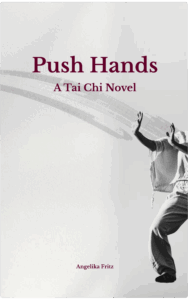
Why I put a lot of effort (and a little humour) into the Chinese names of my Tai Chi Novel
When I wrote my Tai Chi novel Push Hands*, I started describing all the characters. I did not want to randomly assign names, I wanted them to mean something. And finding the right Chinese names turned out to be quite a joy. A little inside joke, if you will.
Chinese names carry a lot of meaning. Each character tells a small story. But since I do not speak Chinese, I turned to the internet and AI to help me research and find the right ones.
In the Taijiquan world, Chinese culture is woven into everything: the terminology, the forms, the teacher-student relationships. It felt important to get the names right, even if most Western readers would never notice the details.
There are three fictional characters in the novel with Chinese names: Zhang Wei, Shīfu Lú Hàn, and Master Wēn Wěbó. Let me take you behind the scenes on each one.
Zhang Wei: the most common name on purpose
Zhang Wei (张伟) is the visiting Tai Chi instructor in the novel, he is the teacher everyone has come to learn from. For his name, I wanted something that reflected a very specific idea: I wanted him to be just a regular person. I went to the internet and looked up the most common Chinese surnames. Zhang (张) is one of them. Then I looked up the most common Chinese given names. Wei (伟) is one of them. Put together, Zhang Wei is roughly the Chinese equivalent of John Smith.
There is a reason why I wanted this to be such a common name. I think, in the Taijiquan community, people with Chinese names (especially people with the names of famous lineage families) often get more credibility simply for having that name. And I wanted Zhang Wei to have exactly that kind of perceived authority in the eyes of his Western students, while being a very ordinary man with a very ordinary name.
I actually considered giving Zhang Wei a different name at one point. I considered something that sounded like one of the great Taijiquan lineage families. And that idea came from something I observed at a real workshop. The visiting teacher had a surname that sounded like one of those famous families. At some point a student asked the teacher directly how he was related. He smiled and explained that he was not and that his name was actually spelled differently in Chinese. It was a slightly awkward moment. But I have always wondered: did he benefit, at least a little, from people assuming the connection before that question was asked? In the end, I kept Zhang Wei as John Smith. It felt more honest.
Shīfu Lú Hàn: a name that carries history
The second Chinese name in the novel is Shīfu Lú Hàn (师父卢汉). He used to be Zhang Wei’s primary teacher, the one who shaped him deeply. Zhang Wei lived with him, trained with him daily for years. Shīfu Lú Hàn was not just a teacher to him. He was almost a father figure.
For the name itself, I wanted it to feel rooted and traditional. Lú (卢) is a common Chinese surname with a long history. And the name Hàn (汉) means Han Chinese: the Han people, the Han dynasty, Chinese identity and heritage itself. As far as I researched, it is not a modern name. It carries weight and history. For a teacher who represents the old way of learning, that felt exactly right.
And that is perhaps the quiet irony of the novel. Zhang Wei may have the most ordinary name in the room, but he learned from someone whose name carries the weight of an entire civilisation. Zhang Wei is actually really good at Taijiquan.
Master Wēn Wěbó: a personal tribute
The third Chinese name in the novel is Master Wēn Wěbó (温伟博), a Taiwanese master from Fangyuan. He appears only briefly. Zhang Wei met him just a couple of times at workshops. But he taught Zhang Wei a push hands concept that is key to my novel.
Now why did I choose that name? Wēn Wěbó (温伟博) is a small, personal tribute to one of my own teachers. This teacher, from whom I learned that push hands concept, is a woman. But for the novel I needed a male character, so Wēn Wěbó became her fictional counterpart.
Wēn (温) means warm, Wěi (伟) means great, and Bó (博) means learned. And Fangyuan (Taiwan)? Well, that is phonetically close to Frankfurt (Germany), where my teacher still lives. So it’s a little nod to my teacher and I think that is quite fun.
An art that crosses borders
These are the three names with three different intentions. One ordinary, one rooted in history, one a little personal tribute.
If this little behind-the-scenes look made you curious, I invite you to read the novel. You can find Push Hands: A Tai Chi Novel on Amazon*.